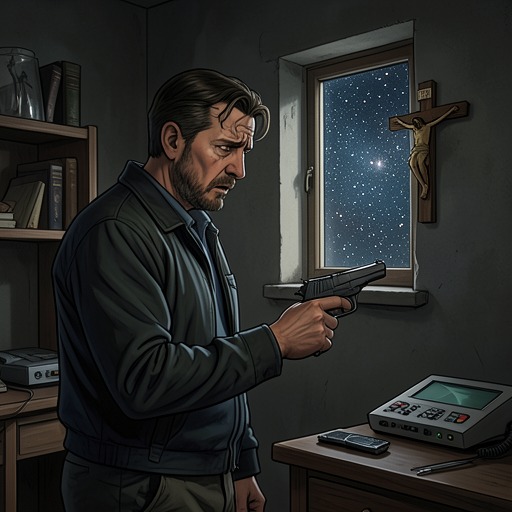
Logical Suicide
The Myth of SisyphusLogical Suicide names the extreme consequence of a metaphysical argument: when existence appears utterly absurd without belief in immortality, the desperate thinker attempts to answer the contradiction by annihilating himself. In the treatment of Fyodor Dostoevsky, the concept is not merely a private act of despair but a dramatic test of what follows when consciousness refuses consolation and insists on completing its own logic.
Definition and Philosophical Premise
Fyodor Dostoevsky’s heroes repeatedly ask what life means, and their questions belong to a modern sensibility centered on metaphysical rather than merely moral problems. Their inquiries do not remain abstract. Because existence is presented as either illusory or eternal, the pressure of the question invites extreme solutions. Dostoevsky’s importance here lies in showing how an intellectual position alters a human life; the artist follows philosophy into its consequences, particularly the consequence he calls logical suicide in his Diary of a Writer.
The reasoning begins with the conviction that human existence is an utter absurdity for anyone who lacks faith in immortality. The imagined desperate man concludes that happiness would require harmony with a totality he cannot conceive and can never reach. He also casts himself simultaneously as plaintiff and defendant, accused and judge, condemning nature for bringing him into being in order to suffer. Suicide therefore appears as a juridical and metaphysical sentence: nature is condemned to be annihilated together with the person who has been forced to endure it.
This position contains a bitter humor because the suicide is, in a sense, taking revenge. The act is meant to prove that he will not be deceived or mastered by the structure of existence. Yet the gesture is not simply surrender. Its motive is a quarrel on the metaphysical plane, an attempt to defeat the conditions of life by refusing to continue participating in them.
Kirilov and the Logic of Freedom
The fullest embodiment of Logical Suicide is Kirilov, the engineer in The Possessed. He declares that he wants to take his own life because it is his idea: death is not an accidental result of suffering but the deliberate execution of a thought. His reasoning returns to the premises of Dostoevsky’s earlier formulation. God is necessary, Kirilov believes, but God does not and cannot exist; the impossibility of reconciling those claims becomes, for him, sufficient reason to kill himself.
Kirilov nevertheless distinguishes his act from revenge. He accepts, through indifference, that his suicide may be used to advance a cause he despises, saying, “I decided last night that I didn’t care.” At the same time, he prepares to die with a mixture of revolt and freedom. He intends to kill himself in order to assert his insubordination and his new liberty. Logical Suicide thus changes the emotional meaning of self-destruction: the act is no longer directed chiefly against nature as retaliation, but against dependence itself as an act of revolt.
The argument reaches its most radical form in Kirilov’s ambition to kill himself in order to become god. If God does not exist, Kirilov is god; if he is god, he must kill himself; therefore suicide becomes the proof of his divinity. The logic is absurd, but its absurdity is precisely what gives the concept its force. Kirilov does not resemble a conventional megalomaniac. He performs gymnastics each morning to preserve his health, rejoices when Chatov recovers his wife, and wants to draw a face sticking out its tongue at “them” on a sheet of paper found after his death. He is childish, irascible, passionate, methodical, and sensitive. His humanity remains fully visible beneath the logic and obsession of his claim.
The Man-God and Earthly Independence
Kirilov’s divinity is not supernatural. In conversation with Stavrogin, he distinguishes himself from the idea of a god-man and instead annexes Jesus Christ to a human drama. He imagines that Jesus, at the moment of death, discovered that his torture had been useless and that the laws of nature had made him live and die within falsehood. Jesus therefore represents the complete human being, not a divine being who escapes the human condition. He is the man-god: the person who realizes the most absurd condition, one in which every human being can be crucified and victimized to some degree.
The meaning of Kirilov’s formula becomes clear when he identifies independence as the attribute of his divinity. To become god is to become free on earth rather than serve an immortal being. If God exists, everything depends on God and human beings cannot act against divine will; if God does not exist, everything depends on human beings themselves. Kirilov therefore treats the death of God as the transfer of absolute responsibility and power to the individual. In this respect his position is linked to Friedrich Nietzsche: killing God means becoming god oneself and attempting to realize on earth the eternal life promised by the Gospel.
Yet the concept contains an unavoidable contradiction. If earthly independence has already been won, suicide appears unnecessary. A person who truly feels himself to be a sovereign would live covered with glory rather than abandon the world. Kirilov knows this contradiction. His response is that ordinary people do not feel their freedom; they remain attached to blind hopes and need someone to demonstrate the path for them. The suicide consequently becomes pedagogical. Kirilov must die first so that others may understand the difficult sovereignty available to them.
Sacrifice, Revolution, and the Paradox of the Ending
Kirilov presents his death as a sacrifice made out of love for humanity. He is to be crucified without becoming merely victimized, because he understands his death as the final assertion of the man-god’s freedom. His melancholy is evangelical, but it is directed toward a future in which human beings will become sovereign. Once he is dead and others are enlightened, the earth will be populated by “tsars” and illuminated by human glory; the pistol shot is imagined as the signal for a final revolution.
The force moving Kirilov toward death is therefore not simple despair. His suicide joins love of one’s neighbor, pedagogical purpose, revolt, and the desire to establish a new human condition. He is unhappy because he is obliged to assert his freedom, and the obligation itself reveals the burden hidden inside absolute independence. The act promises liberation while requiring the destruction of the person who is supposed to exemplify it.
The final affirmation, “All is well,” gives the adventure its strange closure. It does not erase the bloodshed or resolve the contradiction between freedom and death. Instead, it turns the conclusion into an absurd acknowledgment: the world offers no transcendent guarantee, yet the act can still be affirmed as a human decision. Logical Suicide thus reaches victory only by exposing its own impossibility. It seeks to make humanity sovereign, but its representative disappears before the promised world can arrive.
Literary and Thematic Significance
Kirilov’s death provides the model for other characters who attempt to put absurd truths into practical life. Stavrogin lives as a “tsar” of indifference, incapable of detesting anything, while Ivan Karamazov claims the intellectual sovereignty summarized by “Everything is permitted.” They are liberated, in different ways, by the consequences of Kirilov’s death, and their trajectories show that Logical Suicide does not end with the individual who pulls the trigger. Its premises continue as practical attitudes toward responsibility, moral restraint, and power.
The concept also belongs to a wider tragic pattern in which consciousness both wounds and elevates the human being. Sisyphus becomes superior to his fate during the conscious descent from the summit, when he recognizes the full extent of his condition. Oedipus likewise moves from unconscious obedience to fate into tragedy through knowledge, yet finally concludes that “all is well.” These figures differ from Kirilov because they remain within life, but their shared structure clarifies the danger of Logical Suicide: lucidity can become a source of dignity when it is borne, or a fatal argument when it is converted into an absolute command.
Against the tragic affirmations of Sisyphus and Oedipus, Kirilov’s solution abandons the world it claims to free. The broader meditation contrasts the Greek sense of limits with modern attempts to force totality, whether through metaphysics, history, or power. The Greeks recognize that limits exist and that overstepping them invites punishment; Logical Suicide is one of modernity’s most severe attempts to overstep the human limit by making independence absolute. Its significance lies in that paradox: it is an act of revolt against dependence, but because it ends in death, it cannot inhabit the freedom it discovers.